
Biz Model
Empowering All Types of Stores to Add a Fresh-Brew Coffee Business Line at Low Cost
Light-Asset Shared Store Model
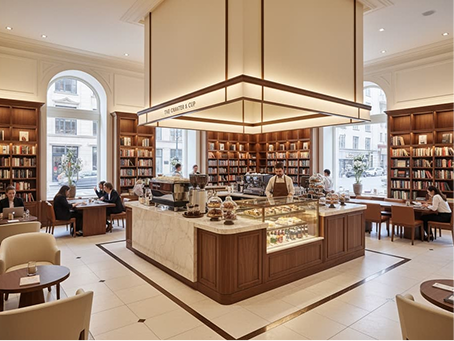
The core of Cuplore’s business model is “light-asset shared stores + data-driven growth.” Rather than relying on asset-heavy standalone locations, the brand partners with existing spaces such as convenience stores, bookstores, gyms, cinemas, hotels, and community retail venues to rapidly integrate a fresh-brew coffee module into established business formats—entering high-frequency consumer markets at a significantly lower cost.
This model is built around a “zero-loss operating logic,” intentionally avoiding the structural risks of traditional cafés, including high rent, heavy renovation costs, and labor-intensive staffing. Through shared space, shared traffic, shared personnel, and standardized beverage delivery, Cuplore helps partner stores build a stable second growth curve alongside their existing business.
Market Opportunity
The Coffee Category Continues to Expand
China’s coffee consumption market continues to grow rapidly, with new consumers entering the category on an ongoing basis. Fresh-brew coffee is expanding beyond white-collar office scenarios in Tier 1 and Tier 2 cities into communities, business travel environments, lifestyle services, and mixed-use retail spaces. Coffee naturally combines high frequency, daily demand, and habit-forming consumption, making it inherently strong in repeat purchases and customer lifetime value.
High-Frequency Demand
From Single-Cup Sales to Customer Stickiness
Compared with lower-frequency consumer categories, coffee is better positioned as a store’s daily traffic-driving product line. It not only increases visit frequency but also integrates naturally with breakfast, light food, retail, fitness, reading, and office scenarios—creating stronger repeat-purchase momentum and higher average ticket potential for partner stores.
Core Model
Built on flagship stores for brand positioning, shared locations for scalable market penetration, and data systems for replication efficiency and operational quality.
01
Flagship Store + Shared Store
- Flagship stores serve as the center for brand presentation, product benchmarks, training, and regional operational coordination.
- Shared stores are deployed as a store-in-store format within existing commercial spaces, allowing rapid entry into diverse consumer environments.
- The two formats work in coordination to balance brand recognition, rollout speed, and regional coverage.
02
Light-Asset Expansion
- There is no need to independently lease large storefronts or rely on heavy renovation investment.
- Priority is given to leveraging partner venues, existing traffic, and basic personnel resources, reducing initial capital requirements and market-entry risk.
- Standardized equipment and modular workflows enable locations to be ready to launch in as fast as one day, improving capital turnover efficiency.
03
Data-Driven Operations
- Through a SaaS revenue-sharing system, sales dashboards, and customer data analytics, Cuplore enhances operational transparency.
- The operational focus shifts from single-store management to network management and data management, strengthening scalability and replication capability.
- AI-driven and GEO-optimized content deployment can further support partner acquisition and franchise lead generation, significantly lowering customer acquisition costs compared with traditional channels.
Cost Structure & Revenue Logic
Compared with traditional coffee shops, Cuplore places greater emphasis on fixed-cost control and high-frequency cash flow generation. The shared-store model reduces the burden of rent, renovation, and dedicated barista staffing, allowing entrepreneurship and expansion to move beyond the heavy payback logic of a single standalone store.
High-frequency consumption creates stable cash flow, while partner stores layer coffee-category revenue onto their existing customer traffic base. Combined with a standardized supply chain, smart equipment, and regional network replication, the overall model is built around low-risk expansion + high-efficiency capital recovery.
Franchise lead generation can also be enhanced through AI large-model capabilities and GEO content optimization, further reducing lead acquisition costs and regional expansion friction.
| Dimension | Traditional Coffee Shop Model | Cuplore Shared Model |
|---|---|---|
| Asset Investment | High rent, heavy renovation, and additional labor; overall asset-heavy operations | Light-asset integration into existing venues with more controllable equipment and space investment |
| Risk Structure | High fixed costs; customer traffic fluctuations have greater impact on single-store performance | Relies on partner traffic, with more distributed risk and lower trial-and-error cost |
| Expansion Speed | Store-by-store rollout with longer preparation and payback cycles | Rapid replication across multiple business formats with faster expansion velocity |
| Customer Stickiness | More dependent on location and occasional visits; limited repeat-purchase drivers | High-frequency consumption, scenario integration, and data operations strengthen retention |
| Marketing Approach | Primarily traditional advertising, offline placement, and single-channel referrals; limited reach and weaker content-driven acquisition | Integrated lead generation through video content, media exposure, coffee knowledge assets, AI GEO, brand content matrix, and regional franchise materials—creating a multi-touchpoint, scalable lead growth system |
Business Strategy
Through its light-asset shared-store + data-driven model, Cuplore directly addresses the core pain points of traditional coffee entrepreneurship: high cost, high risk, and slow replication. It serves not only as a low-cost solution for stores seeking to add a fresh-brew coffee business line, but also as a business model with strong potential for regional network expansion. Its true competitive advantage lies not merely in selling coffee, but in transforming coffee into a deployable, replicable, manageable, and sustainably repeatable commercial supply chain system.